
Rule books are included in some of the purchase options as they cost money to have printed. However, we don't think that it makes very much sense to charge players for the rules of the game. So, we've made the full rulebook available here for free!
Introduction
Welcome to The Elements of Athaera! This rulebook is designed to help new players understand the basics of the game and get started on their journey to becoming a master strategist. Whether you're a seasoned card game player or new to the genre, this guide will provide you with the information you need to enjoy The Elements of Athaera.
In this card game you will use your Unit, Source, and Utility cards to defend your castle while simultaneously trying to reduce your opponent(s) castle to rubble. Each castle has its own Renown and every battling player starts with 50 Renown. The first player to reduce their opponent's Renown to 0 wins the game!
The Elements of Athaera is commonly played with 2 players but its unique design allows for an unlimited number of players to join the battle.
An Elements of Athaera card deck and a set of 7 dice will be needed to play. These cards and dice will be used in a variety of ways to combat your opponent(s) and claim victory.
This is the official rulebook for The Elements of Athaera and should be referred to by all players for the basic rules of the game. Let's get started!
What you need
To play The Elements of Athaera, you'll need the following components:
- -Main Deck: You will need a main deck of at least 40 cards with no more than 60. The maximum number of cards with the same name in your deck is 3.
- -Guardian Deck: A Guardian deck is optional but can have no more than 20 cards. We recommend that you grab at least a few Guardians!
- -Support Deck: A support deck is a group of up to 20 cards that will not be placed on the game field, but will be reserved by you in order to swap out cards from your Main or Support deck at a 1:1 ratio between match games.
A few more things!
Before we dive into the rules, here are a few additional notes to keep in mind:
- -Dice: The Elements of Athaera relies on a standard set of 7 dice to play. -D4, D6, D8, D10, D12, D20, D100.
- -Counters: You may often find the need to count the amount of something on the field, such as Essence. Anything will work as long as its used too keep count and ins't obstructing other players or yourself!
- -Pen, Paper, Calculator: This isn't necessary to play the game, although keeping track of your Unit health and Renown is the best way to know who wins or loses the game!
The playing field
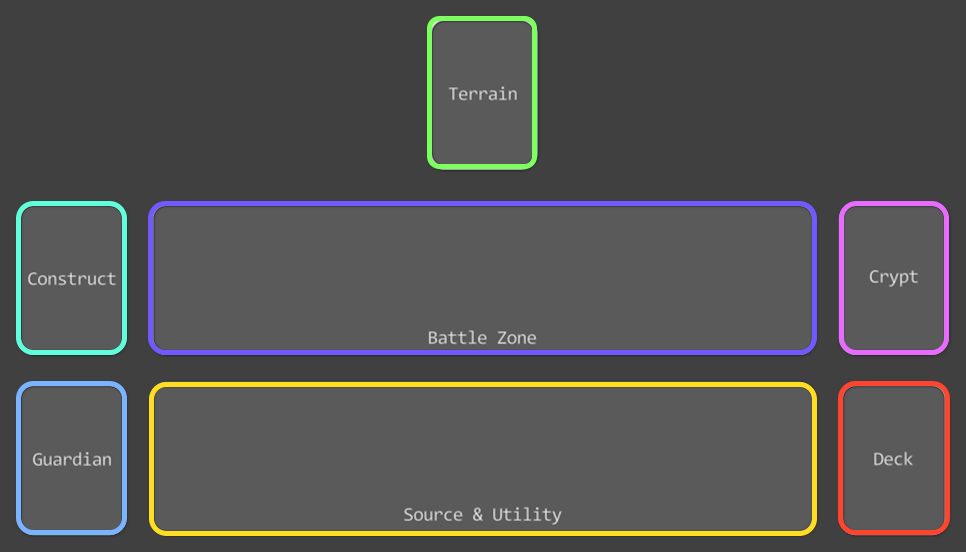
The playing field is divided into 7 zones for each player, each with its own purpose and rules. Understanding these zones is crucial for effective gameplay.
- -Battle Zone: This is where you summon Unit cards there is no limit, they must be summoned vertically, face up or face down.
- -Source & Utility: This is where you play Source and Ulity cards. They are played either face-up, or face-down vertically.
- -Deck: Place your deck here, face-down. Between 40-60 cards.
- -Crypt: When cards are removed from the field, they go to the Crypt. This stack remains face-up and vertical. Either player may look at either Crypt willingly.
- -Terrain: Only 1 Terrain card may be active at any given time between BOTH players. Placed face-up verically.
- -Guardian: Place your Guardian deck face-down vertically between 0-20 cards.
- -Construct: Constructs are placed in the Construct Zone. When adding Constructs to the zone, you may reorganize the stack. Constructs prevent direct attack unless specified by card effect.
Unit cards & abilities
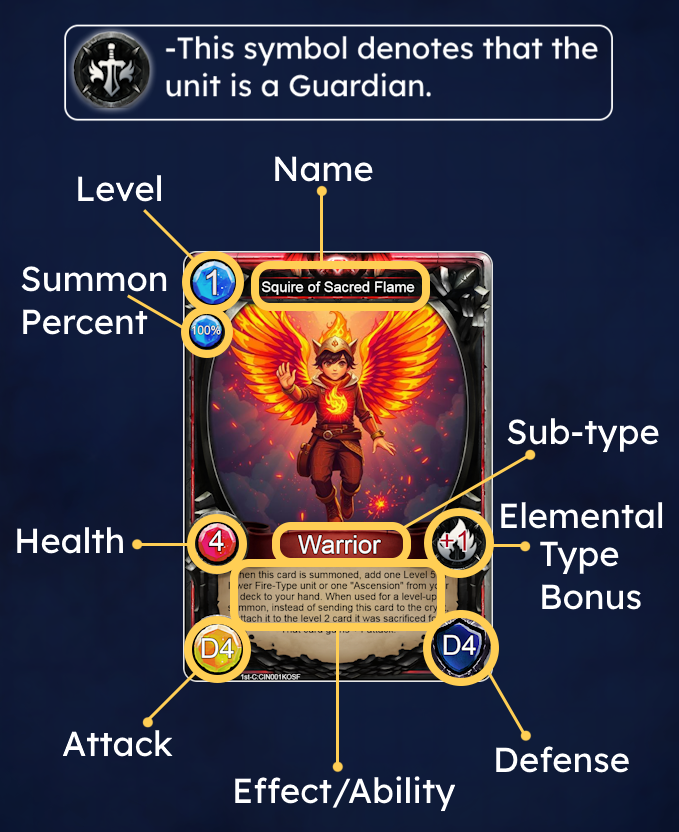
Unit cards are the backbone of your deck and are used to engage in battles against your opponent. Each unit card has its own stats and abilities that can influence the outcome of the game.
- Health: If a unit takes damage, subtract from its health. Once health reaches 0, the unit is destroyed. Excess damage is subtracted from Renown after the unit is destroyed.
- Attack: Roll the listed attack die and add all bonuses. Weigh this against the target's defense,if you win deal the difference in damage to the target.
- Defense: Roll the listed defense die and add all bonuses. Weigh this against the attacker's roll. If you win, take no damage.
- Effects/Abilities: Effects are listed first, followed by Abilities. Abilities cost Essence to use and may only be actived once per turn, per card. Cards must be face-up to be activated.
- Guardian Unit: Guardian Units are special units that exceed level 5. "Ascension" must be used to summon a level 6 Unit, which can then level up normally every turn thereafter.
Source cards
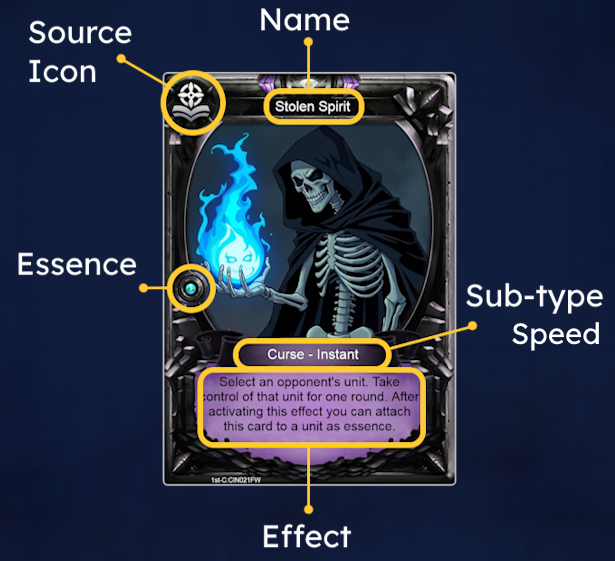
Source cards provide players with resources needed to play unit cards and activate abilities. Managing your sources effectively is key to maintaining a strong presence on the battlefield.
- Sub-types: Terrain-Blessing-Curse-Ceremonial
- Essence: Source cards can be attached to Units as Essence for ability use. If an ability is negated by card effect, the Essence is still spent.
Utility cards
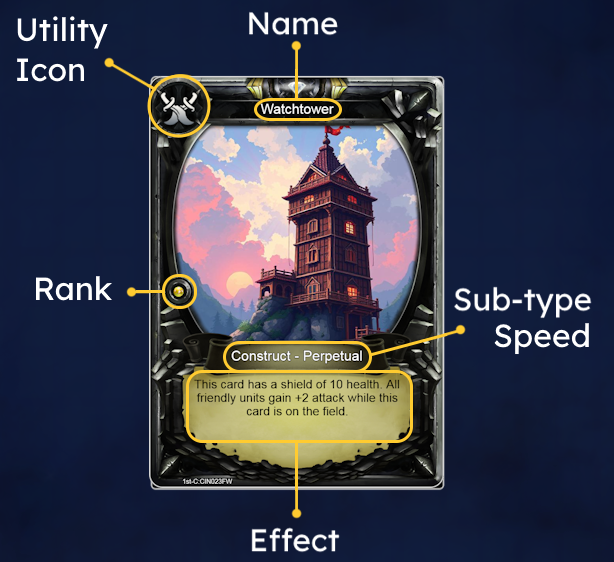
Utility cards offer a variety of effects that can turn the tide of battle in your favor. These cards can be played from your hand and often have unique conditions for their use.
- Sub-types: Equip-Relic-Construct-Item-Currency
- Rank: All Utility cards will have a rank 1-3, increasing in effectiveness.
Summoning & Leveling
Summoning and Leveling up your Unit cards is the primary way to build your force against the opponent and maintain field control.
- Roll Summoning: You may only roll summon ONCE per round. Roll a D100 'percentile' if the result is equal to or lower than the percentage listed on the Unit card, the summon succeeds. You may roll before selecting a Unit to summon.
- Level-up Summoning: You may level up summon ONCE per turn per Unit on the field. This must happen in numerical order, i.e. 1 to 2, 2 to 3, etc. You cannot level up a Unit after that card has been CEREMONIAL summoned during that turn.
- Stealth Summoning: Roll summon, but place the card face-down, after at least one turn, you may reveal the card, thus completing a stealth summon.
- Ceremonial Summoning: These are special types of summons that require Source cards to complete. There is no limit to the amount.
Elemental types
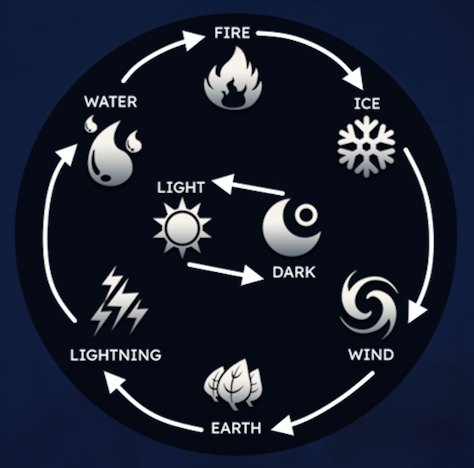
Elements play a key role in The Elements of Athaera, Units will have different elemental types which grants them strengths and weaknesses in battle.
- Types: There are 8
Elements;
FIRE-ICE-WIND-EARTH-LIGHTNING-WATER-LIGHT-DARK - Advantage: The number shown on the Element Symbolof a card is the advantage it has over other elements. Add this value to your attack rolls with that card.
Starting a Battle
The Battle itself is the actual gameplay where you engage in combat with your opponent using your summoned units and strategic plays.
- Battle & Match: One game is called a Battle, best 2 out of 3 battles is a match.
- Winning: Reduce your opponent's Renown to 0 to win the battle.
- Losing: Having your Renown reduced to 0 or having no cards left in your deck to draw at the beginning of your turn.
- Procedure:
-All players must shuffle their respective decks, cut their opponents decks, and place their decks back in their respective deck zones.
-Place any Guardian cards in their respective Guardian Zones.
-Count your Support deck in front of your opponent and set it off to the side.
-All players roll a D20 the highest rolling player goes first. After the battle, the winning player chooses who goes first in the next battle.
-All players draw 6 cards, the player going first draws an additional card as the beginning of their turn.
-The FIRST round is a 'Round of Peace' meaning that no attacks may be made during this turn.
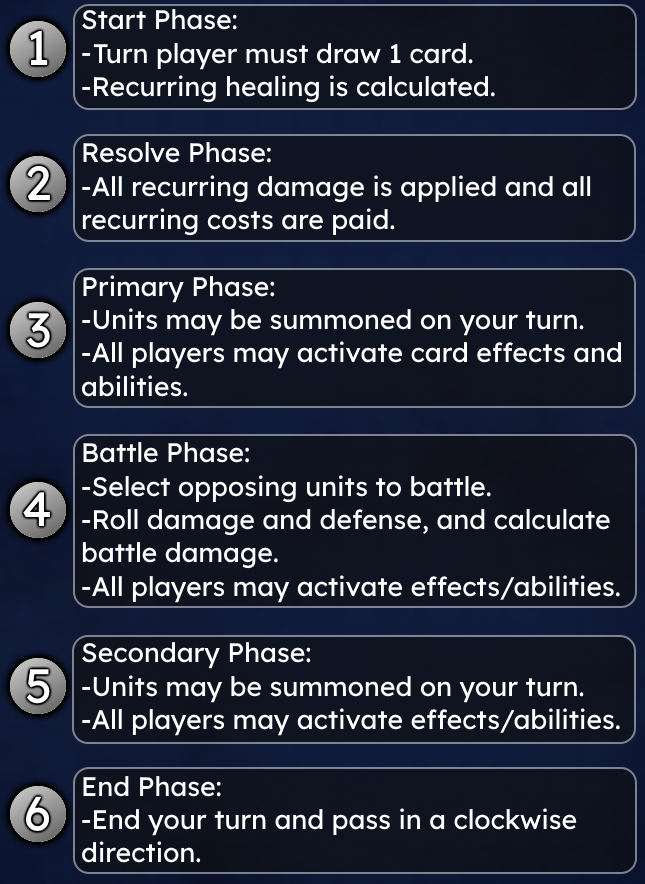
Turn Structure
The structure of the player's turn is important to understanding when and how to play your cards effectively.
- Turn Structure is broken into 6 phases, listed above.
Battle Rules
General rules about Battles and gameplay are explained here.
- Direct Attacks: Bypass enemey units on the battlefield and do damage to either the opponents Construct or Renown.
- Direct Ability damage: Cannot be defended against.
- Shields: Regenerate all damage during the Shield-users start phase. Once a shield reaches 0 health, it is destroyed. Units cannot defend against attacks made to their Shields.
- Damage over time effects: Last until 'Cured'. To cure these effects, at the beginning of your primary phase, roll the same sided dice that the damage was dealt with. The result must be equal to or greater than the original damage.
Reactions and Speeds
Card effects have speeds at which they are activated and resolved in the effect chain.
- Speeds: The speed at which card effects resolve is as follows
from fastest to slowest.
-Instant
-Delayed
-Standard
-Perpetual - Instant: May be played from the hand on either
player's turn.
Unit: Attacks, effects and Summons are all Standard speed. - Reactions: Resolve backwards from the final card played.
- Specific rules always win over general rules.
Extra Information
Any extra information about the game will be provided here.
- 'Turn' vs 'Round': A 'Turn' is a player's turn in the game, while a 'Round' is a complete cycle of turns for all players in the game.
- Turn player 'Priority': In the event that card speeds fall outside of normal rulings, the turn-player takes priority.
- Decoy Units: Unit cards that can ONLY be summoned by card effects. Decoy Units have no stats, but may mimic the effects or stats of the card it was summoned by.
- 'Attack' vs 'Damage': An 'Attack' pertains only to the roll of the dice that was made to direct an attack at a target or player. 'Damage' applies to BOTH Attack rolls and abilities.